News - February 2002
02/25/2002
-
As expected, with the knowledge of the orbits of the Marsden and Meyer sun-near
comet groups, more candidates are found in archival SOHO images. R. Kracht has until
now reported four more objects which move closely on trajectories of the Meyer
group. All four objects are not yet confirmed officially. Additional information is
available
here. (e-mail)
02/22/2002
-
New and unpublished orbital elements of comet C/2002 C1 (Ikeya-Zhang) by
S. Nakano suggest the identity with comet C/1661 C1. Both apparitions can
be linked with a mean residual under one arcsecond. This linkage seems more probable than
with comet C/1532 R1.
(Comets Mailing List)
-
D. Seargent proposed a connection of the Marsden group with the daylight meteor
stream of the Arietids.
(Comets Mailing List)
02/21/2002
-
An archival SOHO comet of April 1997, found by R. Kracht, received the designation
C/1997 G7 (SOHO). As already suggested by M. Meyer on the basis of preliminary
calculations on Feb. 10, this comet is a further member of the Meyer group, which
now contains 7 members. This is SOHOs 390th official comet discovery.
(MPEC 2002-D16)
02/20/2002
-
J. Shanklin and independently M. Magee reported to that with a perihelion
time around May 11 - 12, a Marsden group comet would make a very close approach to
earth around June 10 - 11 (about 0.025 AU for C/1999 J6). Unfortunately this is
post-perihelion, so only bigger members may be seen. Nevertheless comets of both
new groups are best seen from the southern hemisphere, maybe one explanation for the
lack of historic sightings. (e-mail)
02/19/2002
-
The comet group suggested by M. Meyer was finally confirmed. Until now six members
of this group are known. Another group was also identified by B. G. Marsden,
containing until now four members. More details about the Meyer and Marsden groups
can be found on a special page
by M. Meyer. (IAUC 7832)
02/16/2002
-
The latest orbital elements for comet C/2002 C1 (Ikeya-Zhang) seem to confirm
the proposed connection by S. Nakano with comet C/1532 R1, indicating a period in the range
of about 500 years. (MPEC 2002-C111)
02/15/2002
-
New Discovery!:
An apparently asteroidal object, discovered already on Dec. 17, 2001, by
LINEAR and designated 2001 YX127
has been found to be cometary on Feb. 14, 2002, by T. B. Spahr. The maybe
18m comet P/2001 YX127 (LINEAR) will pass in March 2003,
at about 3.4 AU. It is of short period with a P of about 8.5 years. LINEAR has now
found 77 new comets. (IAUC 7828, MPEC 2002-C97)
02/14/2002
-
New Discovery!:
An apparently asteroidal object discovered on Nov. 17, 2001, by
LONEOS and
designated 2001 WF2 showed cometary activity in images obtained on Feb.
23, 2002, by T. B. Spahr. The now 15m comet P/2001 WF2 (LONEOS)
passed perihelion on Jan. 29, 2002, at about 0.98 AU. It is of short-period with a
P of about 5 years and an intrinsically very faint object. The current distance to
Earth is about 0.25 AU. This is the 18th new comet found by LONEOS. (IAUC
7827, MPEC 2001-W42, 2002-C94)
- T. Hoffman found the 389th SOHO comet. C/2002 C4 (SOHO) is a
member of the Kreutz group. (MPEC 2002-C95)
02/13/2002
-
On Feb 03, 2002, the LINEAR project discovered
an asteroidal object in a cometary orbit with P about 25 years and a perihelion
distance of about 1.9 AU. The perihelion passage of 2002 CE10 will
be in June 2003 and it might be possible that the now 19m stellar object
will begin to show cometary activity when coming closer to the Sun. (MPEC 2002-C83)
-
New Discovery!:
An apparently asteroidal object, discovered on Jan. 26, 2002, by
LINEAR was been found to be cometary
on Feb. 11, 2002. The 19m comet C/2002 B3 (LINEAR) passed
perihelion on Jan. 31, 2002, at about 6 AU. LINEAR has now found 76 new comets.
(IAUC 7826, MPEC 2002-C81)
02/12/2002
-
M. Meyer suggests that comets C/2000 C2 (SOHO), C/2000 C5 (SOHO) and
C/2001 T1 (SOHO) are also members of the triplet of comets which he identified
as a group in January. His orbital calculations show that these three comets can be
represented by the same orbital elements as for the triplet. If this can be
confirmed the group would now have six members.
02/11/2002
-
Comet C/2002 C1 (Ikeya-Zhang) increases its brightness faster than expected.
Preliminary analyses indicate a maximum brightness of about 3m at the end
of March. First pointed out by S. Nakano and supported by first elliptical orbital
elements by Muraoka and Sato this comet may be the same as comet C/1532 R1.
(Comets Mailing List)
02/07/2002
-
The 388th SOHO comet is a member of the Kreutz group. C/2002 C3 (SOHO)
was detected by M. Meyer. (MPEC 2002-C28)
02/06/2002
-
New Discovery!:
An apparently asteroidal object, discovered on Jan. 23, 2002, by
LINEAR and posted on the NEO
Confirmation Page has been found to be cometary by M. Tichy and J. Ticha (Klet)
and R. H. McNaught (Siding Spring). The 17.5m comet C/2002 B2 (LINEAR)
will pass perihelion on Apr. 06, 2002, at about 3.8 AU. LINEAR has now found 75 new
comets. (IAUC 7821, MPEC 2002-C27)
02/04/2002
-
New Discovery!:
An apparently asteroidal object, discovered on Jan. 26, 2002, by
LINEAR has been found to be cometary
by M. Tichy and J. Ticha (Klet) and A. Galad and L. Kornos (Modra). Pre-discovery
images by LINEAR of Nov. 8, 2001, were also found. The
17m comet C/2002 B1 (LINEAR) is a periodic one with a P of about
31 years and will pass perihelion on Apr. 20, 2002, at about 2.3 AU. LINEAR has now
found 74 new comets. (IAUC 7817, MPEC 2002-C20)
-
An updated orbit for comet C/2002 C1 (Ikeya-Zhang) shows this comet to
reach perihelion 10 days later on March 18, 2002. This and the changes in the
other elements lead to slightly better observing circumstances. The comet may reach
3m - 4m in March/April. (MPEC 2002-C19)
02/02/2002
-
New Discovery!:
An apparently asteroidal object, discovered by
LONEOS already
on July 28, 2001, and then designated as 2001 OG108 showed a typical
Halley-type orbit but no cometary activity. This activity was now detected. Comet
C/2001 OG108 (LONEOS) will pass perihelion on Mar.
15, 2002, at about 1.0 AU. It is now as bright as 12m and may reach
about 10m. The comet will pass close to the North Pole in April 2002.
The period of this comet is about 48.5 years. (IAUC 7814, MPEC 2002-C04)
-
New Discovery!:
An asteroidal object, discovered on Feb. 01, 2002, by
LINEAR was identified as cometary by
various observers. The 16m comet C/2002 C2 (LINEAR) will pass -
according to the first and very preliminary orbital elements - perihelion on
Mar. 27, 2002, at about 3.3 AU. It will fade. (IAUC 7815, MPEC 2002-C05)
-
A first and preliminary orbit for comet C/2002 C1 (Ikeya-Zhang) shows a
perihelion at about 0.5 AU on Mar 8, 2002. The comet will become brighter and may
reach a maximum brightness of maybe 4m in March, unfortunately too close
to the sun (elongation about 24°). (IAUC 7813, MPEC 2002-C03)
-
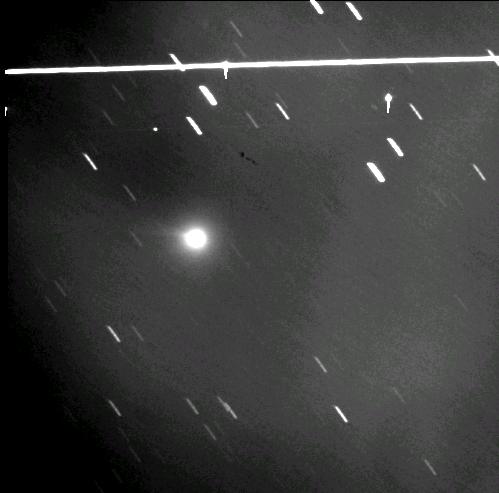
First visual observations of comet 2002 C1 have been collected which seem to
confirm the intial brightness indications and putting it closer to 8m. An
image was taken by L. Robinson (Sunflower Obs., Olathe, KS, USA) which shows
a short tail.
(Comets Mailing List,
Minor Planet Mailing List)
02/01/2002
-
New Discovery!:
A new comet has been discovered visually on Feb. 1, 2002, by Kaoru Ikeya (Mori,
Shuchi, Shizuoka, Japan) and Daqing Zhang (near Kaifeng, Henan province, China).
Comet 2002 C1 is about 8m - 9m with a diameter of
about 3'. It is located 45° from the sun in the evening sky. No orbit is
available yet. Astrometric followup is urgently required. Position for Feb. 1.408
RA: 00h 08.9, Dec -17° 42', motion 10' northeastward in one hour. (IAUC 7812)
The fast motion indicates that the comet is quite close to Earth.
A search ephemeris can be generated on the
NEO Confirmation Page.